
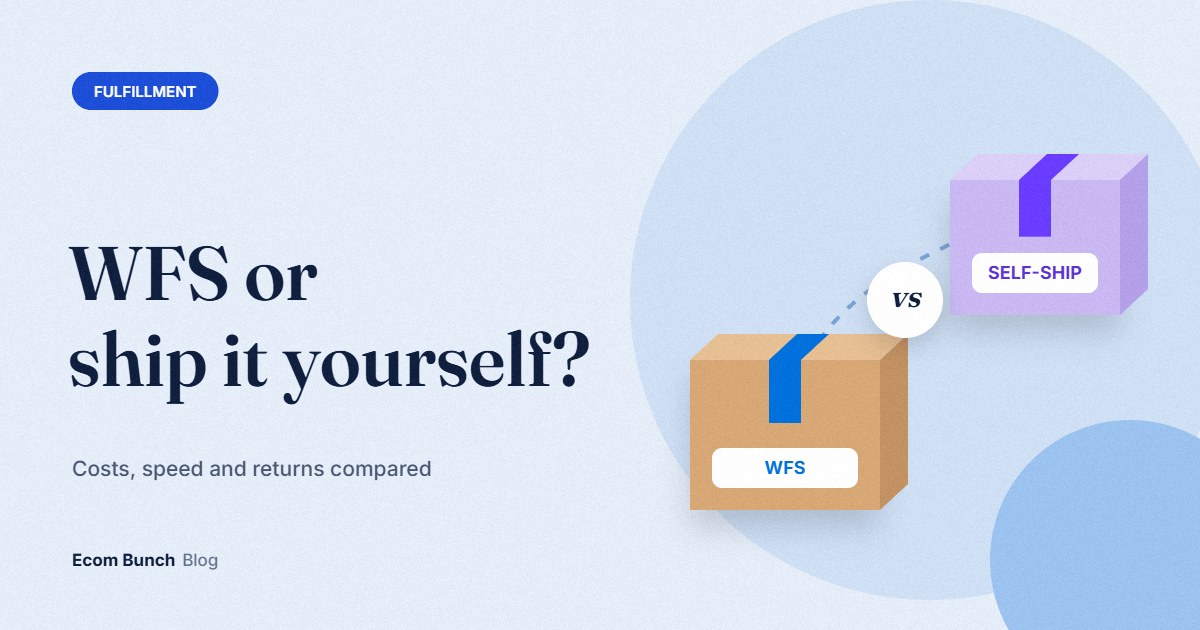

Once your Walmart store is live, the biggest operational decision is how orders get to customers. You can use Walmart Fulfillment Services (WFS), where Walmart stores, packs and ships your products, or seller fulfillment, where you or your 3PL ship each order. Both can work. The right choice depends on your products, your margins and how much of the operation you want to run yourself.
How WFS works
You send inventory to Walmart’s fulfillment centers. When an order comes in, Walmart picks, packs and ships it, handles customer service for delivery questions and processes returns. You pay fulfillment fees per unit (based mainly on weight and size) plus monthly storage fees for the inventory you hold in their warehouses.
How seller fulfillment works
You keep the inventory, either in your own space or with a third-party logistics (3PL) partner. You buy shipping labels, pack orders, upload tracking and run the returns process. You control every step, and you are accountable for every step on your Seller Scorecard.
WFS vs seller fulfillment side by side
| Factor | WFS | Seller fulfilled |
|---|---|---|
| Shipping speed | Eligible for fast-delivery badges | Depends on your carrier and handling time |
| Costs | Per-unit fulfillment + storage fees | Labels, packaging, labor or 3PL fees |
| Returns | Handled by Walmart | Your responsibility |
| Scorecard risk | Shipping metrics mostly on Walmart | Late shipments and tracking count against you |
| Control | Less control over packaging and inserts | Full control over the experience |
| Best for | Small, fast-moving products | Bulky, heavy or slow-moving products |
When WFS is the better choice
- Your products are small and light, so per-unit fees stay low.
- They sell quickly, so inventory doesn’t sit long enough to pile up storage fees.
- You want fast-delivery badges to lift conversion and compete for the Buy Box.
- You don’t want to run a warehouse or manage shipping and returns day to day.
When seller fulfillment makes more sense
- Products are oversized or heavy, where WFS fees eat most of the margin.
- Sales are slow or seasonal, and long-term storage would get expensive.
- You already run an efficient warehouse or 3PL that can hit Walmart’s shipping standards.
- You need custom packaging, bundles or inserts.
Not sure which fulfillment model fits your catalog?
Ecom Bunch has managed 200+ marketplace stores since 2021. Book a free strategy call and we’ll review your store or your application with you.
The hybrid approach most growing sellers use
You don’t have to pick one. A common setup is to send your top sellers, the SKUs that move every day, to WFS for fast delivery and badges, while keeping bulky or slow-moving items seller-fulfilled. Review the split every month: when a seller-fulfilled item starts moving quickly, it may be worth moving into WFS.
How to decide: run the numbers per SKU
- Work out your true seller-fulfilled cost per order: label, packaging, labor or 3PL pick fee, and a share of returns.
- Estimate the WFS cost per order: fulfillment fee for the item’s weight and size plus storage based on how long stock sits.
- Factor in the upside: faster delivery usually converts better, so a slightly higher cost can still mean more profit.
- Decide per SKU, not per store.
Frequently asked questions
Is WFS cheaper than fulfilling orders myself?
It depends on your product size, weight and sales speed. For small, fast-moving items WFS is often competitive once you count packaging, labor and shipping labels. For bulky or slow-moving items, storage fees can make seller fulfillment cheaper. Always compare your full cost per order.
Does WFS help with the Buy Box?
Fast, reliable delivery is one of the factors Walmart weighs, and WFS items are eligible for fast-shipping badges. That typically helps conversion and Buy Box competitiveness, but price and stock still matter.
Can I use WFS and seller fulfillment at the same time?
Yes. Many sellers send their best-selling SKUs to WFS and ship bulky or slow items themselves. A hybrid setup is often the most profitable option.
Who handles returns with WFS?
Walmart handles customer returns for WFS orders. With seller fulfillment, you are responsible for your own returns process and a US return address.
Let us run the numbers for you
We set up WFS shipments, manage inventory and handle seller-fulfilled operations for Walmart stores every day. Learn more about our Walmart WFS management service, compare it with how we run Amazon FBA, or book a free strategy call.